JOURNAL
Discover the stories behind our collaborations with our makers and other creatives.
STORIES & NEWS
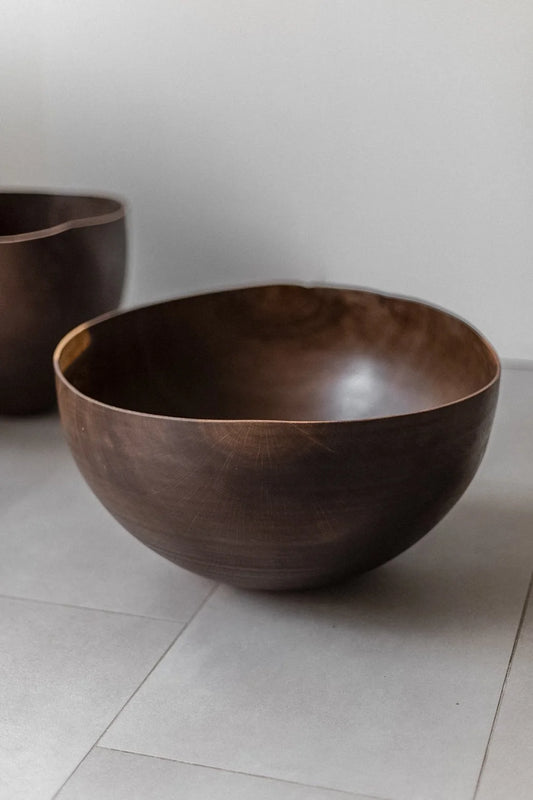
Our Summer Selection of Contemporary Wood
Sculptural forms, stools, vessels. Carved using defining marks and textures, sanded back to soften the grain, the surface limed, waxed, scorched.
SHOP THE COLLECTION
Hans Henning Pedersen ,Alison Crowther, Fritz Baumann & Eleanor Lakelin are four artists creating unique work enhancing wood's natural qualities, echoing forms and textures found in nature. New works by these artists have been added to our online shop and are now available to commission.
Hans-Henning Pedersen Dark Oak Large Vessel
£1,370.00
Hans Henning Pedersen
Danish artist Hans Henning Pedersen works from the island of Bornholm in close connection with nature and his surrounding landscape. The Cherry, Maple and Oak which Hans uses to carve his work from is all collected locally on the island; huge pieces are brought inside his studio where the inside is sawed out and then turned and carved until he reaches a vessel that is beautifully thin before being finished by hand and coated with natural wax.
Shop Hans's Collection
Alison Crowther
Born in Keighley, West Yorkshire in 1965, Alison Crowther is a sculptor and furniture maker working wood sourced from UK woodlands. Crowther's sensitivity to the environment manifests in large-scale works, which are based on and reflect the complex geometry of nature. She observes and responds to her material, guided by the grain and annual rings, her carving forming winding, organic structures, intricate pattern and movement.
Shop Alison’s Collection
Alison Crowther, 'Labyrinth Bench'Private Garden, 2019
Fritz Baumann
Fritz Baumann cherishes the irregularities which can be found in wood; knots, twists and signs of decay from harsh weather. These features promise surprising, asymmetrical and expressive results in his vessels & stools. Spalted wood coloured by a fungus, gives a special aura. Rust water is applied to ebonize some of the pieces, and a white limewash is used to emphasises the natural grain. The finished work holds a story, a minimalist study of nature. It has a simple but flowing line that purposely incorporates the natural qualities of the tree it arrived from, each piece completely unique.
Shop Fritz’s Collection
Eleanor Lakelin
"I use the vessel form & surface to explore the layers of fissures between creation & decay and the erosion of nature."
Eleanor Lakelin is a British artist, creating vessels and sculptural objects in wood. Her distinctive forms are created in response to the passage of time etched into the fibres of the material. Eleanor explores her fascination with the natural properties of wood using a traditional woodworking lathe and centuries-old chisels and gouges alongside modern techniques and tools.
Shop Eleanor Lakelin
We look forward to an exhibiting more of Eleanor's work, next Autumn, along side a collection of Adele Brereton's beautiful jewellery.
Alison Crowther 'Labyrinth Bench' 2019Available to commission
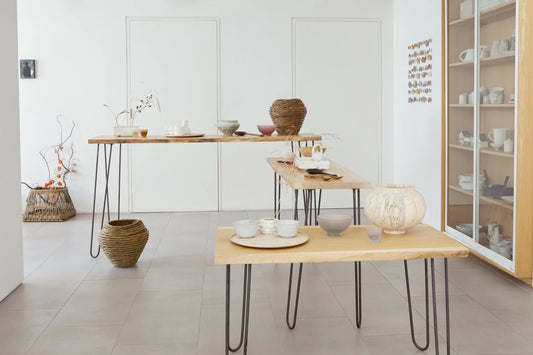
‘Moments of Reflection’ — Exhibition
A collaborative exhibition between island forager, Alex Richards and artists; Max Bainbridge,Chloé Rosetta Bell ,Cécile Daladier ,Alison Dickens ,Celia Dowson ,Tom Fallick ,Iva Polachova andDerek Wilson. Open with works available to purchase online until this Saturday.Each artist has presented a collection of work that allows space for reflection and appreciation of what surrounds us. Alex Richards, chef and wild forager on the Isle of Wight, has shared recipes and advice for foraging close to home which will accompany the selection of objects. The exhibition references function and sculpture to make the most of simple daily habits and contemplation in these unusual times.Curated by Chloé Rosetta Bell. Photographed by Beth Evans

The Poetic Jewellery of Sia Taylor
“The flicker of sun falling through leaves... dust dancing in columns of light… the brush of wind on grasses.” These are the quiet moments Sia Taylor speaks of, interpreting and offering them to us through her delicately handcrafted jewellery.
Sia seeks to capture the emotions that quiet moments of nature evoke rather than directly representing it. She draws inspiration from the infinitely tiny forms and organic irregularities of the natural world; seeds, raindrops, grasses, and leaves reappear in a golden interpretation. Her dynamic jewellery encapsulate the calming sensations found in nature.
“I'm fascinated by the way wind ripples through a field of grass, or how light shimmers on the surface of water. How dust dances in shafts of early morning sunlight...I hope the jewellery is contemplative, quiet, beautiful.”
Celebrating the minuscule and macroscopic, each element is slowly created carefully worked by hand; cut, melted and hammered into shape. They are a refined beauty and have been described as ‘whispering the story of their making.’ You can really appreciate this in their craftsmanship; there is a soul and depth imbued in each piece garnered from the time it has taken to make them.
Recently, like so many, there have been great changes to Sia’s everyday and studio life, but she discusses positively how time has been taken to walk, listen and embrace the natural world around her; “it's Spring, and despite all that has changed, Spring is still Spring - it's been amazing watching how the plants and trees and landscape have changed, the abundance of butterflies, insects and birds that I'm seeing. I love looking at this transformation, and now I have time to really really look.”
With her studio just across a small stream from her house, Sia is able to walk over every day to continue making. Although there is not the usual hum of her team there is still commissions to be fulfilled and so everyday is a work day only now with more time to reflect on her practice and surroundings and rediscover the time to think, draw, paint and read. New ideas have surfaced and are being realised, one leading to the next in a natural flow; “I feel I have been gifted slow time, time to think and daydream and draw and design. It feels as if I'm back at the beginning of my path making jewellery.”
Sia walks in the countryside surrounding her home; “most days I don't see anyone, it's just me, my footsteps, the wind in the trees, birds and insects - It's so calming, and I feel acutely aware of every movement and sound around me.” The softly minimal jewellery echoes this and when worn the natural world becomes infinitely delicate. Each piece a mediation and a reminder of nature's beauty. Sia explains; “quiet moments are transformed into poetic jewellery shimmering with movement, to be collected & worn”

Tableware to Cherish with Jessica Joslin Pottery
Our home and the objects they are filled with have become our world. The home is now our cafe, restaurant and workplace; full of the objects we have collected. These objects provide the backdrop to our daily lives and routines. The tableware we use; from our favourite mug that we drink our tea from to the bowl we have our morning cereal in can shape and enhance our daily experience. Handmade tableware has the ability to add meaning into the everyday. Each object has a story and an emotional connection. There is a joy found in feeling connected to the maker and to the object we hold in our hands.
“They’re quiet pots which are made for daily use.”
Jessica Joslin’s tableware is a combination of functionality and beauty. A palette of muted greys, whites, browns and greens often with iron speckles and drips of glaze. Subtle tonal variations that reveal the colour of the clay underneath. They have a rustic finish which is a nod to her country roots whilst simultaneously remaining modern and simple. They are not fussy or too precious, their beauty lies in their simplicity and balance. They are beautiful objects that are inviting to use. Jess’s throw rings, drips of glaze, squeezes of clay are left visible. “I’m inspired by the process, making slight changes to simplify - removing a step or leaving my markings more visible. What happens if I don't finish with a kidney and leave the throwing rings on this part? Or leaving marks from the glazing tongs?”
“I’m interested in the materials and how they behave, I favour glazes that move and have a lot of variation, revealing drips and faint markings from the glazing process.”
Clay has been the fabric of Jess’ life, starting as a child in her father’s pottery studio and then continuing to study it throughout her life. Her work has a calm sensibility and is beautifully crafted. Jess’ experience and skilled craftsmanship allow her to experiment with glaze and surface texture with her tableware forms remaining sensitive to their intended function.
Since 2013 Jess’ studio has been based inStepney City Farm , East London, where she is a craftsperson in residence. Jess has found her own sanctuary to make her pottery, a slice of rural life in the city. Her farm surroundings and pottery upbringing infuse into her tableware.They encompass a sense of pleasure in making, deep material knowledge and an authenticity.
Jess teaches ceramic workshops, specialising in the potter’s wheel. The rise in popularity of ceramics has given Jess the freedom to focus on her pottery and to be based full time in her studio. The popularity of handmade ceramics has also surged in coffee shops and restaurants. Our love for good food has created a symbiosis between the two, people enjoy knowing the provenance of their food and what it is served on. Beautiful ceramic backdrops enhance the dining experience, fitting with modern sensibilities. Jess’s latest collaborations include restaurants Skosh in York, Ikoyi and Pophams Bakery in central London.
Pophams Bakery was founded by Yvonna’s son - Ollie Gold. The artisanal bakery uses traditional techniques to create hand-crafted pastries and fresh pasta using small, local producers. To mirror their handcrafted food they wanted tableware from a local potter. Tableware that would both withstand excessive use as well as underline the ethos of the bakery. The collaboration between Ollie and Jess started by his selection of shapes and glazes from Jess’s collection to suit Pophams aesthetic. “Now that I have been supplying Pophams for a while the briefs are looser which I really enjoy, there is trust now. I might get a "what about an egg cup?" and then I come up with a few options for them to choose from.”
“The studio is actually very peaceful and I can get fresh eggs which I need for all of the baking I've been doing. I've also dusted off my bicycle and am really enjoying the emptier roads on my commute”.
The farm is currently closed to the public but Jess can still use her studio. The lockdown has pretty much-changed everything in the studio for Jess. Restaurant projects at different stages have all been put on hold. But she is determined to put the time to good use and is finally being able to work on some more personal projects - a wood firing later in the year and work on a larger scale. A couple of summers ago Jess went toAlfred University and spent a week learning about ceramic chemistry. She is now using this time to experiment and put into practise the things she learnt, tweaking her existing glazes. “The farm has become even more of a sanctuary than before. Somewhere I can have a walkabout after lunch and it’s been a busy time with all the lambs. There is something new to see every week and I feel very lucky to have behind the scenes access”.
During moments of disconnection the simple pleasure of good food or drink from our favourite ceramics can provide some comfort. It can instil a sense joy in feeling a connection to the maker, our past, and to the material itself. Jess’ work is available to buy from our online shop.
PHOTOGRAPHY BY SAFIA SHAKARCHI

Welcoming Spring with Lina Peterson Jewellery
A LOOK TOWARDS BRIGHTER THINGS.
Spring is found in the warmth of the sun, the heads of snowdrops dotting banks and the rich assembly of wild garlic. Its colours and sounds mark the change of seasons and offer a simple sense of reassurance and joy during these uncertain times. Lina Peterson’s jewellery encapsulates the budding of spring. Each piece a slice of lasting sunshine. Soft pastel shades are painted onto simple wooden petal-like shapes and blocks reminiscent of flowers in bloom.
Lina absorbs the contrasting patterns and colours found in individual petals; for instance tulips hold the subtle bleed of pink into white and meet contrasting blocks of yellow against red. Lina wants “to capture something of the softness of these flowers, but also the exuberance, the too muchness, the joyousness.” The abstract form of a petal is found repeatedly in Lina’s work forming a key component. Within this form Lina leaves “saw marks and imperfections on the wood, allowing colour and texture to take centre stage.”
The use of colour is central to Lina’s work. Her collections are titled; ‘Testing Colour’ and ‘Carved in Colour’. Each colour combination creates a different emotion. Lina has a painterly application of colour onto wood. She layers thick resins and opaque matte surfaces to form blocks of solid, bold colours which meet the tones of translucent shimmering watercolours. In all, these painted surfaces contrast with the rawness of the wood. Lina studies “how colour and material can come together to create a visual dialogue about process, form, and surface.” She investigates how creative processes can be made visible. The carved blocks have a childlike sense of joy and naivety - building blocks of colour that capture the pleasure of making.
Ideas are generated directly from discoveries made during the making process. Lina sets up working strategies for herself that “include an element of chance as this makes things exciting and unpredictable.” She therefore, might stumble upon, the surface of a cut material, a new colour or how something looked before it was completed, to be explored further. There is a constant dialogue between one piece of work and the next.
For the ‘Carved in Colour’ collection, wood is carved, painted and then carved again to reveal the unpainted wood below. The patterns become a mapping of the making process. A sense of rhythm and movement is created across the surface of each piece. Lina uses carving to make as she sees it as a tool that; “creates a tension between surface and material and between colour and the wood itself.”
Lina has expanded her collection to include wall based work which is an exploration into the application of colour onto wooden panels and the process of assembly. Some panels of wood are carved and painted. Other panels are painted exploring colour application techniques such as the bleeding found in watercolours, mixing paints and resin that are then cut up and assembled. She is also working on pieces that are constructed from a collection of wooden elements with a rough sawn surface, painted in block colours and then assembled. These are interpretations of drawings that in turn come from her embroidered work. The wall based work draws on her “aesthetic language and plays with materiality and colour.”
The new larger canvas seems to allow bolder mark making and brush work. There is a deeper sense of pattern and movement created with the paint. It’s fantastic to see Lina’s work on a larger scale. New compositions are created with wooden panels and blocks collaged together to form a landscape of pattern and colour. Lina has a fifteen year long working relationship with wood she holds knowledge over the processes she uses, but she always aims to surprise herself when making; “to generate results that feel intuitive and fresh.”
We asked Lina how she is continuing her practice during these difficult times. She has been able to set up her studio at home; “I pre-cut some wood before lockdown so am currently doing some painting and sketching and drawing. I’m also able to do textile work at the moment. Other creative projects are taking place while looking after my daughter - such as a theatre and a robot!”
As projects have been put on pause for many of us and the soundtrack to our lives muted, the opportunity to plan new projects arises. This Autumn we hope to showcase a large collection of Lina Peterson’s jewellery alongside her new range of wall pieces. We look forward to brighter times with our Lina Peterson jewellery showcase.
Purchase Jewellery by Lina Peterson.

A Stillness in the Collecting & Curating of Objects
FLOW GALLERY, SITUATED IN THE HEART OF NOTTING HILL, IS A PEACEFUL SANCTUARY FOR HAND CRAFTED OBJECTS FROM AROUND THE WORLD.
As the streets quieten and the world spends more time in the home, we have been looking into the lives of our collectors, seeing how stillness has been created through their collections and curation of handmade objects.
Yvonna Demczynska, founder of Flow, lives surrounded by a remarkable gathering of art and craft. In her gallery home, there is an eclectic mix of materials and objects that meet harmoniously with the soft walls and light streaming in through tall windows.
Woven brushes from around the world including Poland, Japan and Scandinavia are carefully hung and arranged in an open cabinet. While ceramic vessels, plates and jugs, often used, are placed together on a beautifully simple floating shelf. In a quiet nook under the stairs, stillness can be felt in a gathering of a large textured stoneware vessel byEva Brandt and the hand carved, deep wooden bowls byHans Henning Pedersen , both from the Island of Bornholm, Denmark.
Artists alike find tranquillity in the making of objects which can be displayed as landscapes of still life.Malcolm Martin and Gaynor Dowling , collaborative artists working in wood, carve vessel-like-sculptures that draw light and movement across their surfaces. Their work pushes the boundary between a two-dimensional textured surface and the volume of a three-dimensional form.
The pieces byMartin and Dowling share a central role of the hand of the tool. As their still life sculptures move into the collectors’ home they take their audience back to the maker’s hand, the studio in which it was formed and the imagination from which it was conceived. This is perhaps the most generous offering that an artist and their work brings to us. They breathe calm into our homes, creating still moments as they catch the casting sun and shadows throughout the day.
PHOTOGRAPHY BYBETH EVANS

Cécile Daladier's Studio and Garden
Cécile Daladier’s vases, which she calls Pique-Fleurs, are a departure from standard vases for big bunches of flowers. She prefers to give individual flowers more attention. Her previous career as a musician perhaps helps to give the arrangements some rhythm.
A wonderful article inSpace & Process recently described her practice in her studio in Provence more fully, with beautiful photography byLinsey Rendell .
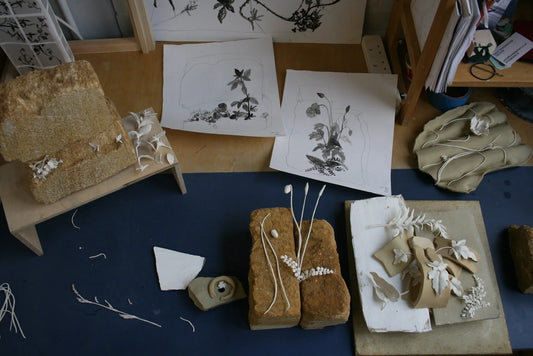
Residency at Forde Abbey
THIS YEAR KATIE SPRAGG & KAORI TATEBAYASHI WERE SELECTED FOR OUR RESIDENCY IN COLLABORATION WITH SOMERSET ART WORKS. AN EXHIBITION OF THE WORKS RESULTING FROM THE TWO RESIDENCIES WILL OPEN ATFORDE ABBEY 22 SEPT - 31 OCT 2017
Flow Gallery in collaboration with Somerset Art Works and with the support of The Arts Council grants arranged two residencies of one week for artists who work in urban environments yet whose work is deeply influenced by gardens and meadows.Forde Abbey owners very kindly provided a perfect environment with its magnificent gardens and a grand house ( originally a Cistercian Abbey) full of history. It was to be a retreat from city life, time out to experiment and draw and write.
Here's Katie Spragg's wonderfully descriptive account of her recent residency at Forde Abbey House and Gardens:
In May earlier this year, myself and Kaori Tatebayashi spent a week at Forde Abbey, a still family-owned grand house, gardens and surrounding land on the Somerset/Dorset border. We arrived from London on a glorious May evening and immediately set out to explore the gardens.
It was certainly very picturesque with the golden light dappling across the great lawn and dazzling off of the three ponds dotted across the gardens. The gardens at Forde Abbey are a great mix of curated, planned landscaping and areas left to be 'wild'. The meadow grass, a particular favourite of mine, as those who know my work will know, was in full flower with purple clovers and yellow buttercups. Circling the great pond at the top of the garden we found an overhanging tree with ferns growing from it, and the beech house, a highlight of our brief planning-visit a few months earlier, then a mass of twisting curling branches was now a leafy outlook across the lake.
In these rainy few days we occupied ourselves with sketching and painting, drawing outside when it wasn't wet, taking hundreds of photographs, visiting the local Harvey Stone quarry where I filled the back of Kaori's Mini with lumps of stone from their waste pile, catching newts with jam jars and a bright torch late at night, sleeping in our four poster beds in the abbey, eating hearty lunches in the cafe and going on a tour of the family's goat farm, pick-your-own strawberry farm, private pond and learning some of the details about farming. It felt like a completely different world to what I know from my suburban upbringing and now living in London.
For our final two days the weather improved. I spent a day running a workshop for a group of local school children; we toured the gardens - painting with sticks and dandelions and using the 10 foot fountain to create a 'drawing' before the children made an amazing installation from clay, modelling two worlds that merged in the middle - one a landscaped garden, the other a space where nature had taken over.
On the last day, myself and Kaori completed our residency by driving to the families private pond where I took my first outdoor dip of the year, it wasn't as cold as I'd (feared and) expected!
I became really interested in the confluence and contrast between the curated nature of the Forde Abbey gardens; the lumpy topiary yew trees, mowed lawns and the shapely ponds alongside the untamed areas free to grow bracken, bramble and dock leaves and areas of meadow grass. Also the planted rock garden and then the welsh poppies, maidenhead ferns, succulents and clovers that grow from the stone of their own accord. It was this that has inspired five new works that I have created for our exhibition in the abbey in September, as well as being inspired by the materials of the abbey itself - I have worked with stone and coloured glass for the first time."