JOURNAL
Discover the stories behind our collaborations with our makers and other creatives.
STORIES & NEWS
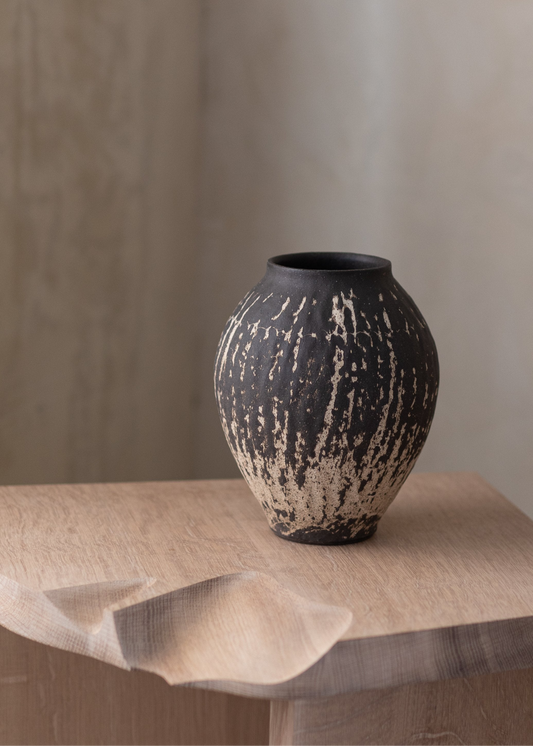
An Interview with Tamotsu Suzuki
We're delighted to showcase at Flow the Japanese ceramicist Tamotsu Suzuki,whose pieces translate the power of nature through organic forms and the materiality of clay.
"I am in awe of plants with delicate & tough forms. I feel them at our fingertips, soaking our thoughts into the soil. I reconstruct plants that quietly stand as if they had grown naturally on the spot." - Tamotsu Suszuki
Where is your studio based?
My studio is located at the foot of Mt. Yatsugatake in Yamanashi Prefecture, at an altitude of 900 meters, a place rich in nature. The area is very cold in the winter, but the summer is comfortable and you can enjoy growing flowers and vegetables.
Is being surrounded by nature important for your practice?
I live in an environment where I could touch nature on a daily basis. Plants change with the seasons, and their shapes, scents, and textures all stimulate the five senses. Spending time with plants may even be more enjoyable than pottery.
What techniques do you use to create your pieces?
My work is hand-formed. I try to leave traces of my hands. On the surface, I use a "Kohiki" style slip. I work with red clay that has a lot of iron; I use it because the fired clay becomes darker and contrasts with the Kohiki slip. "Kohiki" is originally a technique to make it look white, but it shows various expressions depending on the iron content of the clay, the shade of the slip, and the combination of the glaze. I sometimes use white slip to get a black matte texture.
Can you tell us about the forms you like to work with?
It's hard to decide which forms are your favourites. I enjoy making every item. If I dare say it, it's a vase with a high degree of freedom in shape.
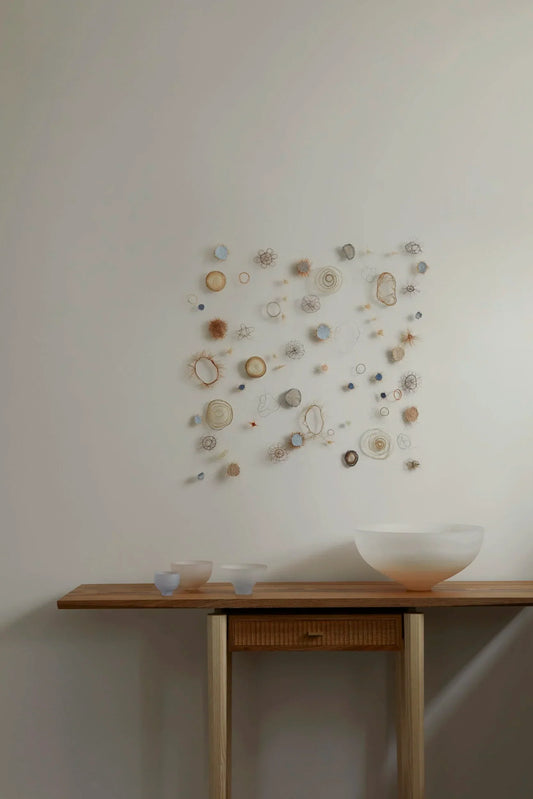
‘At Home’ with Flow Gallery at Collect 2023
Flow is looking forward to participating in Collect 2023 at Somerset House. Our stand for this year will focus on creating the feeling of the home through various textures, forms and materials. Featuring two furniture designers, Sandy Buchanan and Made by Bill, the space reflects our most intimate domestic environments.
Through layering the space with crafted works, our stand for Collect 2023 will emulate a collection made over time. Our objects will be curated amongst commissioned furniture by designerSandy Buchanan andMade by Bill .
Discover Ceramics by renowned Artists Akiko Hirai, Masamichi Yoshikawa, Derek Wilson and Maria Kristofersson. International Artists Cécile Daladier and Marian Bijlenga . Glass by Celia Dowson. Ceramics by Upcoming Artist Chloé Rosetta Bell. With Textiles by Claire Benn.
Gallery Owner, Yvonna Demczynska
Furniture by Sandy Buchanan and Ceramics by Chloé Rosetta Bell

An Exhibition by Swedish Ceramic Artist Maria Kristofersson
Line drawings are the basis for her work in clay – delicately coil-built constructions in clay can be seen as three-dimensional drawings. The fragile and vulnerable are juxtaposed with robust and strong shapes. The familiar utilitarian forms of boxes and cylinders act as a canvas for her subtle surface textures.This new body of work, shown for the first time at Flow Gallery, has a newly expanded, "earthy" colour palette, together with the restrained monochrome colours of terracotta, white and black.
"The container can hide, preserve or protect. It is the intrinsic meaning of its function that interests me, not its practical purpose."
— Maria Kristofersson
British Textile Artist Claire Benn lives and works in a converted barn in Surrey. Inspired by remote and wild landscapes.
“ A piece of cloth (usually linen or hemp) is always my starting point. Earth pigments provide the colour and connect me back to the land. Soya milk binds pigment to cloth and enables me to communicate the visual details found within the landscape. Thread is the final addition, adding quiet accents and a literal surface texture that fingertips can feel. These are my quiet materials, used to make art that evokes solitude, stillness and silence. ”
— Claire Benn
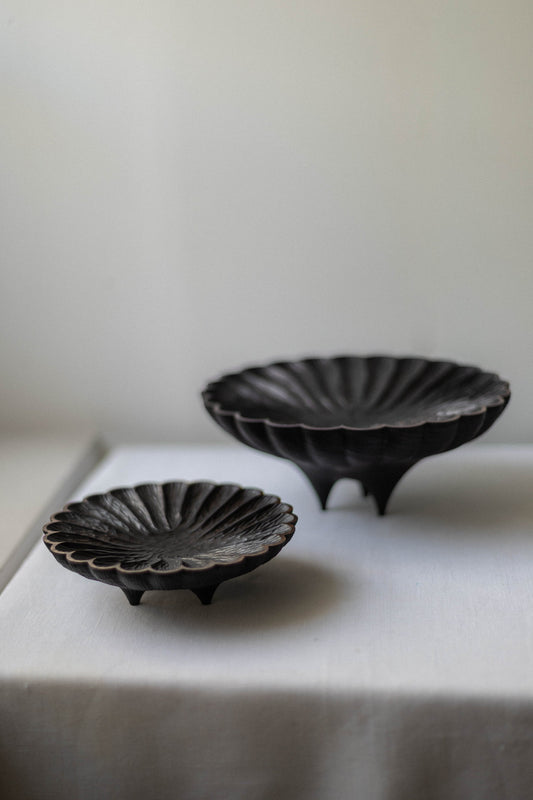
An Interview with Etienne Bailleul
We are delighted to share the work of French Artist Etienne Bailleul.His sculptural woodwork is a welcomed addition to Flow Gallery.
Where are you currently based?
I’m a sculptor and designer living and working in Lower-Normandy, France. As a self-taught woodworker, my approach is exploratory and evolves with my skills and my knowledge of the material.
What is your approach to the wood-carving process?
From sourcing the wood to the final object, each piece is the achievement of a slow process. Taking time in the process is really important for me. It's a matter of respect for wood, my own rhythm and understanding of the material. I always keep in mind the living being behind the material and this relationship to time and growth. That's why I like to spend as much time as possible with my pieces in progress. A piece of wood in my workshop is both a trace of the past and something in the making, a particular sensitive moment when the material tends towards another state.
How does nature and the organic material you work with inspire you?
Fascinated by nature and influenced by organic shapes, plant biology, and the fragile balance of nature, I create delicate pieces between sculpture and function. Concerned with sustainability, I only use locally sourced wood and work mostly with hand tools. After millions of years at our side, trees stay mysterious, strange, and beautiful. They have played a considerable role in the evolution of human beings, and we wouldn't be here without them. It’s this connection through the ages that makes the act of carving wood so much more meaningful and deeply powerful for me.
Are there particular plant forms that you are drawn to? Why?
I use powerful and delicate shapes to express the beauty and the fragility of nature. I’m mostly inspired by plants – simple organisms that are extremely durable and resilient. Always adapting, evolving, using a diversity of incredible mechanisms to multiply – all of this with elegance. Flowers are a great example because the delicate petals hide an ingenious and very effective way to expand, attracting pollinators with beauty in different ways. It is life, coming from an extraordinarily delicate, fragile and ephemeral organ. This is not vulnerability, but strength.
How do you explore form and surface in your work?
Curves are omnipresent in my work: they represent the flow of time, change and the movements of matter, and seek to express the softness of organic lines. The textures on my pieces represents the complexity inherent in each thing composing our world, and the characteristic of everything being composed of billions of particles. This is my way of trying, in some way, to understand this world and the essence of things. The surface, now enlivened, plays with the light, and also reflects my own sensibility.
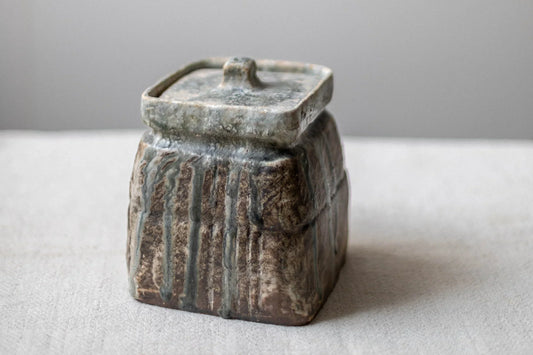
Paul Philp on Throwing
Welcoming six new works by renowned Studio Potter Paul Philp, all hand-thrown and hand-built from his studio in Bath.
For the past 40 years, Paul Philp has most commonly worked with hand-building methods to make his work due to the strong sculptural aspects of his forms, some being sculptures rather than pots. However, in this new collection, Philp has explored throwing. Paul Philp explained to us that he looked at throwing to reduce the scale of his work this summer. At the age of 81, his large forms were becoming physically demanding. He wondered if throwing and subsequently turning the pots would allow him to keep exploring his practice. Paul also notes that through the exploration of throwing and turning. He has discovered new ways that his glazes work within his pieces, finding that sometimes they are more effective than on his hand-built pieces that require a dryer surface. His new vessels at Flow are a mixture of glazed and semi-glazed pieces and are his personal pick of his recent thrown work.
"In fact, I don't particularly enjoy throwing but I do enjoy turning - and you can't have one without the other."
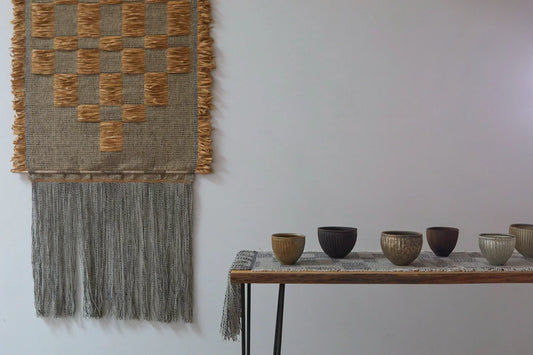
‘Searching for Apricity’ – Maria Sigma & Nancy Fuller
Apricity :(n.) the warmth of the winter sun
A New Duo Show by ceramicist Nancy Fuller & weaver Maria Sigma
17th November 2022 - 17th January 2023
The two practices of Nancy Fuller and Maria Sigma have a natural synergy. Both are inspired by a raw connection to nature in their choice of mediums and techniques, sensitively responding to the shifting seasons. Whilst preparing this duo exhibition, Sigma and Fuller discovered the word ‘Apricity’ – an English word that has fallen out of use. ‘Apricity’ refers to the warmth of the winter sun; it evokes the precious moments when one can bask in the sun during the coldest of seasons, and be cheered by bright sunlight amidst dark surroundings. This poetic meaning has been translated into the work they individually prepared for this show.
For Maria Sigma, the need to “grasp the sun”, as she puts it, is intimately connected to her personal history of growing up in Greece. While creating her woven pieces, Sigma’s memories of sun-drenched summers infuse her work:
“My main inspiration, like images in my head, come from Andros, the Greek island where we are from. I didn't grow up there, but I spent all my summers there, and it was the more natural environment I had… So in all my memories, it's summer there – the landscape, the really bright sun, the contradiction between the sea and the rocks, the white of the Cycladic architecture. But then I use materials, especially the wool, which is quite British, and wintery. In something that could be very wintery, I'm trying to translate something which in my head is more summery. It's always very abstract. And then there are streaks of orange silk, which I find is a really sunny orange.”
The orange silk delicately streaming through materials like wool, linen and paper stands out like a sunbeam. Sigma is committed to using undyed threads and fibres, and this vivid orange silk is no exception; sourced from India, its bright colour comes from the silkworm’s feed. The raw materials is something Sigma is drawn to: ‘I'm very interested when yarn has a nice, natural, undyed state.'
She explains the multiple reasons for choosing undyed materials:
“One reason is sustainability: it takes less energy, less toxins, less water consumption to make. I really like to use the closest to raw fibre yarn; although it is spun into a yarn, its the least processed I can have, the wool is just cleaned and spun, that's it. Nothing else. The same goes with the silk, which is hand spun. Another reason is that I really like colour. I think they are so beautiful as they are, and they're getting unnoticed when we dye them - so why not using them as they are. It's more of a challenge to find these kind of colours, that occur naturally, when you can create everything now, any colour you want.” - Maria Sigma
Ceramicist Nancy Fuller’s work has an inherent connection to the landscape. Her pieces are wood-fired in rural Aberdeenshire, and each firing carries traces of the season:
“If I fire in a different season, I get different colour effects. Every firing produces a different palette of colours, no two firings are the same, no two pots are the same. It's to do with the atmosphere in the kiln; it's very hard to explain, there's a lot of unknowns. For example, this time I fired in autumn, and I got a lot more of the deeper oranges and darker greys. In the summer firings, using the same clay body, I was getting pale creams and light greys. It can vary that much.” - Nancy Fuller
Rather than using glazing, the colour variety comes from the unique response of the clay body and the effects of the wood ash. Fuller uses woods that are available locally, mainly firs and beech, and so literally uses the landscape in her process. Her pieces become deeply rooted in their surroundings, as she explains, the effects of the ash “depends on your firewood, what minerals are in the wood and where the trees are grown.”
“Where I grew up in the North East of Scotland, the winter days that you do have a bit of sun peeking through the dark forest are precious times. That's why I chose these pieces, that were a darker clay body, some with a little bit of gold leaf over the top of them. Just catching the light in small details. My work is so tied to the season I am firing in. You have to slow down and your whole focus becomes on the firing, and then that focus opens your awareness to your surroundings – you become more in tune with them. When I'm choosing the titles, it's whatever came to mind that I paid particular attention to.”
The names of Fuller’s pieces – ‘Autumn Flush’, ‘First Signs of Winter’, ‘Return to Earth’, ‘The Scent of Land’ – are all responses to Fuller’s subjective experience. They are the story of her practice – ‘The Scent of Land’ relates to the smell of firing, and the unique scent that each natural place has. Above all, the titles are also ‘how I experience nature’, and evoke her perception of the seasons and the earth around her.
Photography by Beth Evans
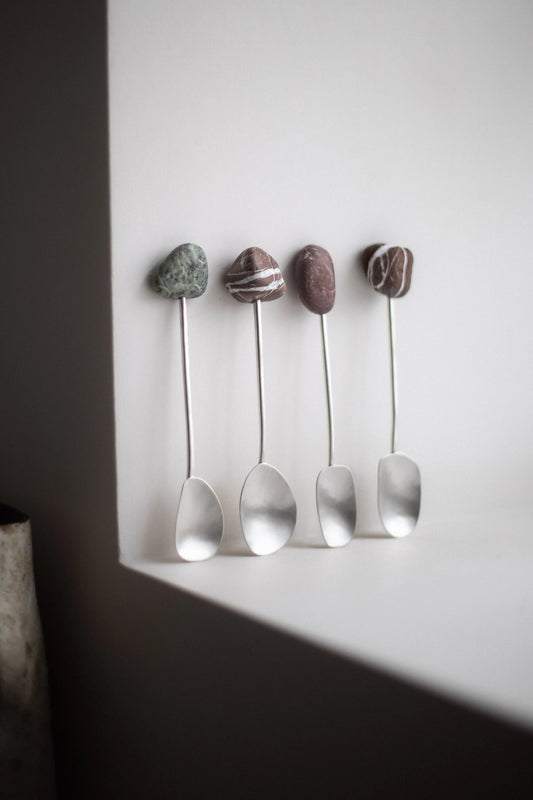
Thalia-Maria Georgoulis
We welcome to the gallery pebble spoons by Greek Silversmith Thalia-Maria Georgoulis now available in the gallery.
Thalia-Maria Georgoulis is a Greek silversmith. Based in Athens, Greece. Her practice began as a jewellery designer before deciding to pursue sculptural objects on a larger scale. Thalia-Maria completed an MA in Goldsmithing, Metal-Work and Jewellery at the Royal College of Art in London. She has since worked exclusively as a silversmith. Her work celebrates the beauty of simple, everyday objects of nature, tradition and ritual.
View Available Work
"WHAT I LOVE ABOUT THE SILVER PEBBLED SPOONS IS THAT THE POSSIBILITIES ARE ENDLESS, AND EVERY NEW PIECE REMAINS UNIQUE AND BEAUTIFUL IN ITS OWN ORGANIC WAY. EACH PEBBLE HOLDS A PERSONAL STORY, AS WE CAN ONLY IMAGINE WHERE THAT NATURAL STONE FIRST STARTED ITS HARMONIOUS JOURNEY AND STUMBLED INTO MY PATH."

Makers & Museums: Announcing Ireland 2023
We announce our upcoming Makers & Museums tour of Ireland in May 2023, celebrating the best of Irish craft and design
Monday 08 May – Monday 15 May 2023
IRELAND – Where time-honoured traditions are kept alive in Craft and Design
Discover why Ireland is such a melting pot of creativity, brimming with rich history, inspirational landscapes, language, music and vibrant Irish imaginations.
On a truly special tour, experience the best of Irish craft and design. Toss down a pint of Guinness and let the warmth and the smiles of the Irish sweep you away on a journey across the country to see the work of the most talented designers and craft artisans, inspired by Ireland’s striking landscape.
Makers & Museums , assisted by The Design and Crafts Council Ireland, have created an itinerary that takes you to every corner of the country to meet Ireland’s best makers, and the opportunity to be expertly guided through the finest galleries and related museum collections.
Ceramic sculpture by Derek Wilson, Belfast
Irish craftsmanship is intimately entwined with the nation’s majestic natural scenery. We travel from Belfast to Ballintoy and wind our way through iconic coastal landscapes to the start of the northern section of the Wild Atlantic Way at Ardara, where we see the majestic Slieve League cliffs. From there we head south to Galway, Kinsale and back round to Dublin. At every corner of the country, we discover pockets of vibrant creativity.
The itinerary of studio visits will provide a window into the artists’ worlds, and an exclusive insight into their practice. Among the artists we will visit are the glass-blowing duo Scott Benefield and Andrea Spencer in their studio on the north Antrim coast, the highly-esteemed basket weaver Joe Hogan, and the celadon glazed porcelain and stoneware by ceramist Derek Wilson, as well as countless others.
While in Belfast, we will have a curator-led tour of the prestigious Ulster Museum’s Craft and Design Section and the Craft NI Gallery, showcasing emerging local artists and designers. In Dublin, our visits will include the Collins Barracks: part of the National Museum of Ireland where collections of contemporary craft and design are displayed, including those of the famous modernist Irish architect and designer, Eileen Gray.
When visiting the makers’ studios there will be opportunities to purchase works directly from the artists.
Wood wall sculpture & vessel by Alan Meredith
In Belfast, we will be based at the luxurious Fitzwilliam Hotel near the Opera House, and in Dublin at Dylan Hotel, a 5* Boutique set in historic buildings.
Join Flow Gallery owner, Yvonna Demczynska and museum adventurer, Cathy Giangrande and discover why Ireland’s craft is full of joy and spirit. And, that’s why they say, ‘All you want is in Ireland’!
What’s Included
Overnight stays, highlights include :
- 2 nights’ accommodation at 5* Fitzwilliam Hotel, Belfast on a B&B basis
- 1 night at Dean Hotel, Galway
- 1 night at Absolute Hotel, Limerick
- 1 night at Dean Hotel, Cork
- 2 nights’ accommodation at 5* boutique Dylan Hotel Dublin
Private group curator tours:
- The Ulster Museum
- Craft NI Gallery
- The Hunt Museum
- National Design & Craft Gallery
- Limerick School of Art & Design
- Collins Barracks at Decorative Arts & History Museum in Dublin
Glass sculptures by Andrea Spencer
Fine Dining, including:
- Breakfast, lunch & dinner throughout
- Welcome dinner in the Great Room at the Merchant Hotel Belfast
- Michelin Bib Gourmand ‘Home’, in Belfast
- Award winning ‘Dax’ and ‘Glas’ in Dublin
Studio & exclusive visits, including:
- Over 15 artist studio visits, showcasing ceramics, wood, furniture, glass, silversmithing, weaving, and more
- A basket weaving masterclass and visit to the the studio of esteemed basket weaver Joe Hogan
Ceramic sculptures by Mike Byrne, based in Limerick
For Further Details
For further information and a full itinerary, please contact Yvonna at Flow, info@flowgallery.co.uk or Cathy, cathygiangrande@gmail.com.
Numbers on this tour are limited to 12, so early enquiries are essential.

Cloth of the Earth
Untamed yet elegant the collection strikes theperfect balance between form and function.A tale of nature’s innate power and beauty.
De le Cuona’s woven natural yarns are refined and skilfully crafted with a strong earthy aesthetic. On the table beside Paul Philp’s timeless archaic circular vessel is Enrico Donadello’s tall cylinder carafe. Enrico’s slips and glazes have an earthy palette contrasting with a sculptural form.
In a bedroom setting the raw yet delicate oxides layered on Eva Brandt’s White Coral Vessel sit beside De le Cuona’s soft subtly slubby linens. And in a final touch, Kei Tominaga’s Folded Silver Tray catches the passing light of the day.
Photographer: Jake Curtis, Set Design: Alex Kristal
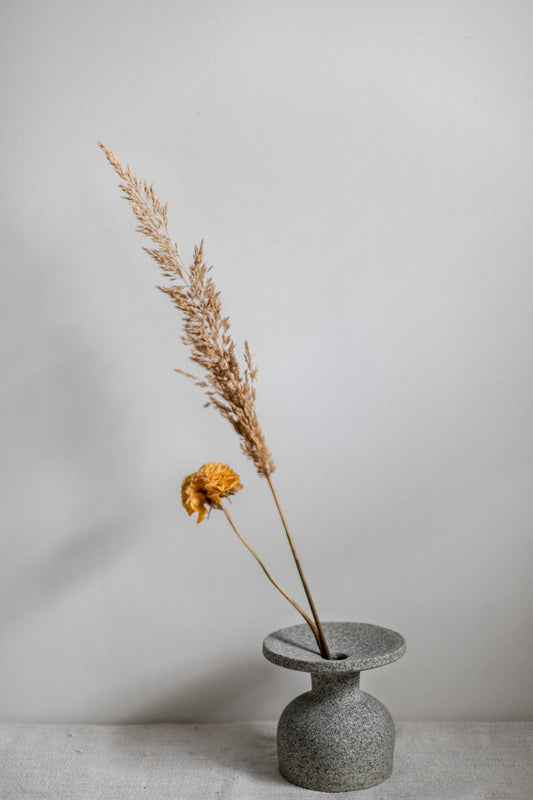
Enrico Donadello
Enrico creates stoneware objects from his studio in Italy. Each vessel is inspired by sculptural geometric forms and shapes that are brought to life with tactile textures, bridging the gap between rawness and perfection.
"Surrounded by traditional crafts and shaped by many years working in the field of design my work moves across the familiar and the unexpected.."
“My process is a slow analysis of forms & construction.I always start with a shape in my mind that evolves& changes as the piece reveals itself.”

Material Statements: A Visit to Nina Malterud’s Solo Exhibition in Kode, Norway
I have been admiring Nina Malterud’s ceramics since the first time I saw her oval wall pieces about nine years ago, at Collect on the Format Gallery stand. I was thrilled when Nina agreed to showcase her wonderful ceramics at Flow Gallery.
Nina is one of the most accomplished ceramic artists I know. She has been a prominent figurehead of Norwegian art since the 1970s, when she became a key artist in the “new ceramics” movement. Her genre-defying work continues to captivate, moving between the realms of craft and fine art.
Nina has achieved widespread and distinguished recognition, both in Norway and internationally. Just this August, she was duly rewarded in August by HM the King of Norway with a Knighthood of the 1st class of the Royal Norwegian St. Order of Olav for her achievements in art and education. Earlier in 2022, Nina received the highest Norwegian Prize – the Ulrik Hendriksens Ærespris 2022 – with a financial award of 250000 Norwegian Krone (approx. £22,000).
Four years ago, Kode, a highly prestigious museum in Bergen, Norway, invited Nina for a solo exhibition. The exhibition features over 150 works, spanning her illustrious, 50-year career from 1975 to present.
I was delighted that with the help of the Norwegian Embassy in London I could visit the exhibition. In fact, I visited on the penultimate day of the four-month long retrospective.
The design of the exhibition was carefully planned by Nina and the exhibition architects, to guide viewers through every stage of her career. The large room was divided into different sections, showcasing a variety of approaches and techniques.
As you enter the large exhibition space, the text introduction gives an evocative picture of her practice:
Nina Malterud has been working with ceramics for nearly fifty years. From the day she established herself as an artist, she has been a key figure in setting the agenda in her field. She played an active part in the reorientation that took place in the 1970s, which led to a reappraisal of ceramics and crafts and their acceptance as art forms. Today, her own art moves effortlessly between categories such as crafts and fine arts.
In her early years, Malterud made mostly cups and pots, before gradually moving on to larger vessels and decorative objects. She drew inspiration in particular from the ceramics of the Minoan culture and the Nordic Iron Age, but she also gives a nod to Norwegian rosemaling (rose painting) in some of her floral motifs. After the turn of the millennium, Malterud continued with earthenware, but with a freer approach. Today, she prefers to work with surfaces in smaller formats that frequently allude to classic ceramic products such as tiles, tablets and dishes.
Fired to a temperature of 1,060 degrees Celsius, powdered glaze turns to liquid glass. Glazes applied layer upon layer interact with each other in the course of multiple firings to produce images and patterns. Using this approach, objects can be reformulated countless times. Cracks and gaps in the glaze can be fatal errors, yet they can also become features in a complex and mercurial idiom. Some of Malterud’s surfaces prompt associations to skin and vulnerability, others suggest the processes of nature or the weather. Most of her works, however, can be regarded as purely abstract art. In the artist’s own words: “I strive for an expression that has physical presence yet without narrative.”
I wish this exhibition would tour to the UK – especially as the response to Nina’s work at Flow has been tremendous! We at Flow look forward to presenting more of her work to UK audiences, and hope many will have the opportunity to see her pieces.

An Interview with Weaver Lizzie Farey
Lizzie Farey’s process starts at her home in the rolling hills of Scotland where she grows and harvests her own Willow which in turn is beautifully woven into fluid and organic shapes.
What was your starting point for the exhibition?
“Natural spaces and forms provide the basis and inspiration for my work. I am particularly drawn to the woodlands and wild places around my home in rural Dumfries and Galloway. I have always sought to create a strong sense of atmosphere and connection in my pieces, leaving the viewer with an impression of where I have been, and the solitude and tranquillity felt.'Sanctuary' includes a body of work that provides deep healing and a sense of coming home to a protective and self-nurturing place. Weaving is a nurturing process and reflects a season of change and nesting. These ideas are mimicked in the tight bundle forms and shapes that aim to communicate and reach out to the people interacting with the object.”
What inspires your making process?
“I develop my ideas through the manipulation of natural materials; primarily, my work explores the mystery of nature. The objects allow me to express myself, not with words, but in the reverence of the materials and weaving process. The need to keep balancing and weaving twigs together is always present - to make sense of everything. I view the practice as a desire to manipulate the material into a beautiful object, working things out by using my hands and connecting with the material. The process mimics our internal way of working problems out but through the use of our hands. I start each piece with intention and have a direction; however, as the piece develops, I explore new shapes and forms, and you have to embrace the element of not knowing how it will look at the end! When it's finished, I look at it has something that pleases me; I know very well if it's not going to work and if it's finished or not.”
Can you describe your making process and the time that goes into each piece?
“There are a few stages to my work. Collecting the Willow and bringing it home to dry is extremely important to me. When I'm ready to create a new piece, I re-soak the Willow, so it becomes flexible and ready to use. I begin to form each piece over 2-3 days. Once I feel the piece is completed, I let it dry out completely in the studio for a few weeks. I embellish each piece with Bog Myrtle and Heather and coat it in wood wax to help nourish the Willow and add longevity so it won't need any maintenance.”
Where does your Willow come from?
“I grow my Willow near my home in Scotland. I love watching the Willow grow with its beautiful leaves blowing in the wind. During the winter, the Willow gets cut and brought home. This process is intertwined into my being, the process of growing and bringing it home to craft objects with. Throughout the years, I have travelled and visited extraordinary established basket makers who grew their own Willow. I was able to take a collection of cuttings from them to plant in Scotland and begin my own process of growing Willow. A favourite cutting in my Willow field is a fine beautiful French willow which is purple in colour and dries to a green-grey.”
How does your work help you connect to nature?
“My practice is deeply connected to nature. I go to the Willow Fields and watch it grow. I spend time in the fields, drinking coffee and find this a deeply healing and connected time. In the winter, when they get cut and brought home, I deeply understand the cycle of growing and gathering. A self-sustaining and natural process has built a love and respect for nature. I feel a lightness, an ancient way of being and an internal exploration into the beauty of working with natural materials.”
“Gathering Materials, even one single wild daffodil, watching insects and birds and butterflies in the willow fields convey all the answers and inspiration for my work and life. My work, in turn, expresses the wildness of nature, the beauty, tranquillity, solitude and harmony that contribute to a balance in the world.”
How would you like people to feel when interacting with your work?
“I want my objects to help people imagine a place where they feel calm and rested. I want people to feel a sense of serenity around the objects and see them as an Anchorage from which they can thrive, whilst feeling the sense of tranquillity and solitude that when into the making process.”
“My work also aims to help people express who they are through objectivity, in a way that words cannot! This is an outward expression of our internal thinking, emotion and desires. A sense of self. The work provides an inner safe place, a sanctuary where I can develop these ideas and reach out to others. Making these objects using materials collected from the willow field, wild marshlands, moorlands, and further rolling landscape outside my studio, I seek to immerse the viewer in that landscape.”

Constructed Vessels
Derek Wilson uses the vessel as a means of artistic expression by exploring free and geometric abstraction. The process of disassembling elements associated with archetypal vessels that are reconstructed into complex abstract structures is at the core of Wilson’s practice.
View Available Work

Alabaster Stone by Oliver Cook
New work has arrived in the gallery by Oliver Cook. His subtle translucent alabaster sculptures explore light and movement in everyday objects and the materiality of stone.
Self-taught, his technique has developed organically over time, employing traditional carving techniques and skills learned through woodwork and ceramics.

Prose Poetry by Akiko Hirai
Carefully curated at Flow Gallery “Poetry Prose’ is a much anticipated Solo show by Akiko Hirai. This body of work reflects the unspoken language of objects and the way we can communicate and interact through craft. Hirai’s intention is that the body of work becomes whole through the poetic interpretation by the viewer and the way her work makes them feel.
“In spoken language, everyone has a different style to how we tell things; a kind of unorganised, un-systemised way of communication. You learn how to use your material, like painter does visual language, the poet has their own verbal style, and the musician their own style of composing. They all communicate with the audience. This is happening in pottery too; everyone’s work speaks its own language. Anything handmade which people make from scratch is a kind of language, there are words in it. We can compose poetry from what we see.”
“Visual information is actually very, very strong information, so even if you don’t want it to, it will reflect on your work. It’s not a direct expression, but you feel it. That’s another inspiration for the title ‘Prose Poetry’ – in poetry, you don’t need to use any description of the feeling, and instead you can describe the scenery. Yet through it, you can see how that person looking at that scenery is feeling.”
Akiko Hirai

Prose Poetry
11am - 6pm 7th July Private View – Akiko will be at the gallery 2-5pm
Akiko Hirai’s new collection explores multisensory responses to objects – how sight and touch form an unspoken “language”. Although she starts with the same clays and glazes, Hirai’s meticulous firing process creates an enormous textural and tonal variety in her ceramics. In the kiln, every vessel undergoes its own experience, giving each piece its own unique poetry. The viewer, in turn, brings their own subjective perspective. It is this ambiguity that inspires Hirai, as both maker and viewer compose their own “poem” in what they think they see.
The title ‘Poetry Prose’ reflects Hirai’s interest in the unspoken language of objects, and the communication that is possible through craft. This process is completed by the viewer, who reads the “words” of her ceramics, and creates their own poetic interpretation.
“In spoken language, everyone has a different style to how we tell things; a kind of unorganised, un-systemised way of communication. You learn how to use your material, like painter does visual language, the poet has their own verbal style, and the musician their own style of composing. They all communicate with the audience. This is happening in pottery too; everyone’s work speaks its own language. Anything handmade which people make from scratch is a kind of language, there are words in it. We can compose poetry from what we see.”
The minutiae of everyday experiences are a key visual influence in Hirai’s work. She explores how the seasons gradually transform her surroundings, and the feelings these sights can evoke. For her, visual information filters into the unconscious mind, and then resurfaces in her ceramics.
“My everyday life is my inspiration. I go swimming every morning – I observe the seasonal changes in light, the reflections on water while you’re swimming, the sensation of water. As I’m walking from my home to the studio, I notice how things get greener and are growing. That kind of seasonal movement always affects me, it comes out in the work. Visual information is actually very, very strong information, so even if you don’t want it to, it will reflect on your work. It’s not a direct expression, but you feel it. That’s another inspiration for the title ‘Prose Poetry’ – in poetry, you don’t need to use any description of the feeling, and instead you can describe the scenery. Yet through it, you can see how that person looking at that scenery is feeling.”
The interaction between the senses is significant in Hirai’s work. Touch and sight come together: she explains how “We don’t realise, but we see things in other senses too. Then we process the information, and that brings us back to past feelings as we make a connection to what we experienced before.” The mind’s inclination towards a sense of order impacts how we see, too. Hirai points out how if you see “something broken, and it looks a little bit strange or incorrect to the eye, we try to adjust that in our head. If it’s not complete, it’s completed in our head. An optical illusion is created in that way.”
As well as textural variety, Hirai’s work is concerned with the subtlety of tone and the interaction between multiple layers of colour. This effect builds on the tendency to “complete” what we see through the eye. Hirai feels this liminality creates a sense of beauty. In her work, this is achieved through the use of white:
“I don’t use very bright colours, it’s more like tones. My white is like a veil. You can see through to something underneath; when you put a sheet of white all over, you canimagine something underneath. I like the saying “I am not interested in the moon without the cloud”. It’s a very cultural thing, perhaps Japanese especially. If the moon has a slight cloud, hiding the moon itself, and you can just see the shadow of the moon. That is more imaginative, more moody, and more beautiful than that big, round full moon and the clear sky”.
Akiko Hirai
Hirai’s solo exhibition of her new work will be shown at Flow from the 8th July - 9th of September, including a private view on the 7th July. Hirai herself will join us at the gallery from 2-5pm.

Solo Exhibition by Chloé Rosetta Bell
Residency & Supper Club by Ceramic Artist Chloé Rosetta Bell
19th May - 30th June 2022
A collection based upon a residency with Flow in Wales developing glazes from the seaweed, mussel shells and the chalk residue produced from washing Halen Môn’s sea salt. This is a progression from the tableware Chloé created for Sosban & The Old Butchers, a Michelin starred restaurant in Anglesey, which celebrated their local supplier Halen Môn.
“The sea salt Halen Môn make is really special. It's incredibly pure and so carefully made on Anglesey. The residue left when they wash their salt is a concentrated chalky paste that I thought I might be able to use. The glaze has this matte surface from the mussel shells, but you have these touches of purple and green that sort of bleed down the forms. The ferociousness of the salt when in the kiln eats the surface of the glaze. You can really see the impact of the glaze meeting the mussel shells on the kiln shelf. I hope you enjoy the kind of peaceful chaos that my pieces have.”—@chloerosettabell

Thirty Vases
A private commission for a house in Notting Hill: elegant rooms with angular furnishings and plenty of natural light. Flow commissioned Artists Vezzini & Chen to compose thirty vases to centre the dining table.
Photos by Chloé Rosetta Bell
Please email info@flowgallery.co.uk if you are interested ina private commission with one of our artists

A look inside our stand at Collect 2022
23rd - 27th February 2022 Somerset House, London, Stand E14
With the afternoon light streaming in each day hitting ‘The Collector’s Shelf’ by Fred Rigby Studio and our curated objects. There is a pause amongst the busyness of London and the rush of the fair itself. Discover Ceramics by renowned Artists Akiko Hirai and Paul Philp, International Artists Cécile Daladier, Studio MC and Nina Malterud. Glass by Upcoming Artist Celia Dowson. Wood by International Artist Fritz Baumann and Textiles by Jo Barker.
Read more in the latest FT ‘ No place like home for craft fair Collect’

A New Collection of Earrings by Jeweller Ami Pepper
Situated along the Pembrokeshire coast, Ami is inspired by the traces of the tides and the intricate clusters of seaweed pods.

For the Home
"Instead of thinking, 'this is what I've made - someone can show it,' now I realise that I want someone to live with it."
We take a look at Modern Rustics' latest Artisan Feature on our Ceramic Artist, Lisa Stockham.
Lisa’s colours are muted and neutral, but what gives her ceramics their character is the variety of shades, layered and streaked with freehand marks. She’ll often use dark clays as a base – reds, blacks or grogged pinks – scraping it with her hands or scratching lines into the surface in her own equivalent of abstract painting and adding a coat of slip before the first firing to create texture. Then she’ll build up layers of slip or glaze, leaving the ‘brush strokes’ in white or grey, before firing again.
Photography by Beth Evans

Introducing Lola Lazaro Hinks
We are delighted to have a small collection of work by Artist Lola Lazaro Hinks. Lola works primarily in kiln-formed glass and works from a collective studio in South East London. Interested in the potential glass has to always leave something unseen. Continuing her exploration into the oscillation between concealing and revealing Lola has developed a series of ‘Peephole Containers’.
"The containers subtly conceal what is kept inside, hinting its form and colour through the boyd of translucency, and only revealing when one peers into them. The act of looking is heightened."
The Spherical and Moon Jar influenced forms are small enough to fit in ones hands, amplifying this sense of preciousness once more and exploring a more haptic world of vision. The concave lensing in the peephole creates an illusion of distance, making everything a miniature. This lensing creates an otherworldly dimension, a tiny precious space where something of emotional value can be kept. Perfectly suited for jewellery the containers elevate whatever is inside, to both conceal them safely in mystery and reveal them only to those who choose to peer in.
"The containers allow the owner to keep something precious inside and to bring whatever it is, an object or an heirloom into focus, accentuating the very act of giving one's whole attention to what is meaningful."
Studio Portrait Ester Keate

Paul Philp Crafts Magazine
“The past is a deep source of inspiration for Paul Philp. For the last 60 years, the ceramicist has been quietly creating vessels inspired as much by ancient artefacts as by the work of British modernist sculptors. Central to his style is an exploration of surface. Created through a minimum of four firings, his trademark matte textures can be spotted or grainy, cracked or smooth, often recalling geological phenomena such as the erosion of rock.”— Isabella Smith
Photographer: Chloé Rosetta Bell

Derek Wilson
We welcome into the gallery a new collection of work by Derek Wilson.
Derek Wilson works from his studio in Belfast. He produces a limited amount of functional ware, and we are delighted to showcase a beautiful collection of cups at the gallery. Derek recently created a tableware line for Chloe’s flagship stores globally— but his main focus is his sculptural work.
An unapologetic thrower, Derek consistently challenges his discipline. Focusing on his approach to making, he combines his minimal aesthetic with craftsmanship, a wealth of material knowledge and a propensity to propel modern ceramics through a reinterpretation of its form.